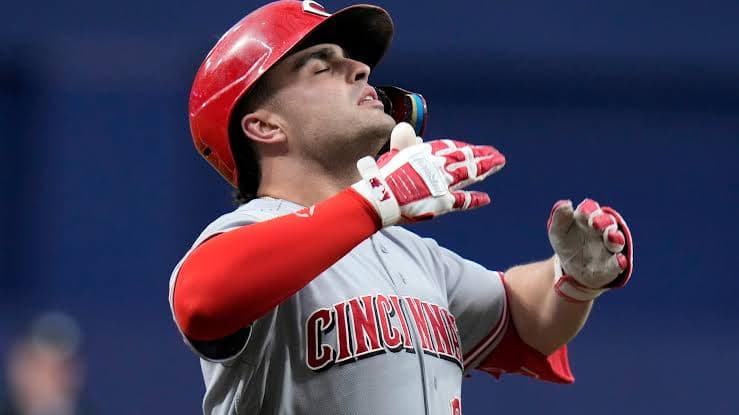
There have been plenty of impressive rookies in the National League this season.
JJ Wetherholt has emerged as an all-around difference-maker in St. Louis. Nolan McLean has put together another strong season on the mound for the Mets. TJ Rumfield has worked his way into the conversation as well.
But as the season moves deeper into August, it is becoming increasingly difficult to look past what **Sal Stewart** has done for the Cincinnati Reds.
This isn't just a good rookie season anymore.
Stewart has become one of the most productive hitters in baseball, earned an All-Star selection at just 22 years old and already placed his name alongside Joey Votto and Frank Robinson in the Reds' record book.
Entering play on August 13, Stewart is batting **.256 with a .332 on-base percentage and .472 slugging percentage**, giving him an **.804 OPS**. He has hit **25 home runs**, collected **23 doubles**, driven in **86 runs** and stolen **12 bases**.
The number that jumps out immediately is 86.
Stewart isn't just producing at an impressive rate for a rookie. His RBI total has him among the leaders in all of Major League Baseball.
For a 22-year-old playing his first full season in the Majors, that type of production is difficult to ignore.
Stewart has been producing from the beginning
*Sal Stewart rounds the bases after a home run on May 20, 2026. Photo via @Reds on X.*
What makes Stewart's season even more impressive is that it hasn't been built around one dominant month.
He entered 2026 with expectations after showing flashes during his September call-up the previous year, including an impressive postseason debut. Still, there was no guarantee his bat would translate this quickly over a full Major League season.
It didn't take long to get an answer.
Stewart collected **three hits on Opening Day**, becoming the first Reds rookie to accomplish that feat since modern rookie rules were established in 1958. He also became the first Reds rookie to hit cleanup on Opening Day.
A few days later, he was named **National League Player of the Week**.
Then April turned his hot start into something more serious.
Stewart finished March and April with nine home runs, and his .570 slugging percentage led all qualified rookies. His performance earned him **National League Rookie of the Month honors**.
At that point, it would've been easy to dismiss it as the explosive opening month of a talented young hitter.
Except Stewart kept producing.
He kept hitting for power. He kept driving in runs. And even after opposing pitchers began adjusting to him, he remained one of the most important bats in Cincinnati's lineup.
That distinction matters in an award race.
There are rookies who explode onto the scene for a few weeks. Then there are rookies who prove they can handle the adjustments, slumps and constant changes that come with a full Major League season.
Stewart has increasingly looked like the latter.
His strike-zone awareness stands out, too
One of the more unusual statistics from Stewart's season says a lot about his understanding of the strike zone.
Major League Baseball introduced its **Automated Ball-Strike challenge system** this season, allowing players to challenge certain ball-and-strike calls.
Stewart has taken advantage of it better than any hitter in baseball.
As of August 13, he has won an MLB-leading **24 challenges in 42 attempts**, a **57.1% success rate**.
That doesn't determine whether someone should win Rookie of the Year, but it adds another interesting layer to Stewart's offensive profile. He isn't simply going to the plate looking to crush fastballs. For a 22-year-old hitter, he has shown an advanced understanding of the strike zone.
FanGraphs also recently calculated that Stewart had generated more run value from successful ABS challenges than any other player through the period it studied.
For someone already doing this much damage when he swings, his confidence in knowing when *not* to swing has become another part of what makes him so dangerous.
This isn't empty power
Twenty-five home runs will grab attention, especially from a rookie.
But Stewart hasn't built his season by simply hunting pitches he can pull over the left-field wall.
One of his strengths has been his willingness to use the entire field. Earlier this season, MLB noted how many of his hits were spread from left-center through right-center, an approach that has made it more difficult for pitchers to attack him one specific way.
The quality of contact is there, too.
Statcast currently has Stewart at roughly a **90.3 mph average exit velocity** with a **barrel rate around 14%**.
And then there is the run production.
Stewart doesn't have 25 home runs with 50-something RBIs.
He has **86**.
RBIs obviously aren't an individual statistic in the same way OPS or wRC+ are. A hitter needs teammates to reach base before he can drive them in.
But somebody still has to bring those runners home.
Stewart has done it repeatedly.
One of the best examples came on April 15 against the Giants, when he hit two three-run home runs and finished with six RBIs.
Then he produced another six-RBI performance at Yankee Stadium on June 20.
That game made Stewart the **first Reds rookie since RBI became an official statistic in 1920 to record multiple games with at least six RBIs in the same season**. He became only the 12th MLB rookie to accomplish it during that span.
That's not some statistic pulled from an arbitrary three-game stretch.
No Reds rookie had ever done it.
He's already climbing the Reds' record book
*Reds rookie Sal Stewart celebrates during his historic 2026 season. Photo via @Reds on X.*
This is where Stewart's Rookie of the Year case begins to feel different.
He's not only putting up some of the best offensive numbers in his rookie class.
He's putting together one of the best rookie power seasons Cincinnati has ever seen.
On August 6, Stewart hit his **25th home run of the season**.
That blast moved him past Joey Votto and into sole possession of second place on the Reds' all-time rookie home run leaderboard.
The only player still ahead of him?
**Frank Robinson.**
Robinson hit 38 home runs during his legendary rookie season in 1956.
That's the company Stewart is keeping.
Earlier in the season, he was already moving into rare franchise territory. By the time Stewart earned his All-Star selection, he had become only the sixth Reds rookie to hit 20 home runs within his first 100 Major League games.
Now he's at 25 with plenty of baseball still to play.
Thirty-eight remains a long way away. Stewart would need another major power surge to seriously challenge Robinson's record.
But whether he gets there isn't really the point.
When you've already passed Joey Votto and the only name remaining above yours is Frank Robinson, you've had a special rookie season.
He became an All-Star for a reason
*Sal Stewart in the Cincinnati Reds City Connect uniform on April 11, 2026. Photo via @Reds on X.*
Stewart's first half earned him something even more meaningful than a place on a rookie leaderboard.
It earned him a spot in the **2026 MLB All-Star Game**.
Stewart was selected to the National League roster through the Player Ballot alongside teammate Chase Burns, making him one of just **four rookies selected to the All-Star Game** this season.
That matters.
Rookie of the Year debates can sometimes become so focused on a single version of WAR or one advanced leaderboard that the actual season begins to disappear underneath the numbers.
There should still be room to recognize what has happened on the field.
Stewart entered his first full Major League season and almost immediately became one of Cincinnati's most important hitters.
He has played every day.
He has hit in the middle of the lineup.
He has produced power.
He has driven in runs at an elite **Major League** level, not simply an elite rookie level.
And before the season had even reached its halfway point, his peers had helped vote him into the All-Star Game.
That's a Rookie of the Year résumé.
The case for JJ Wetherholt is real
None of this means Stewart is running away with the award.
Far from it.
His biggest competition remains **JJ Wetherholt**, and Wetherholt deserves the attention he's receiving.
Wetherholt's value extends well beyond his bat. His defense at second base and baserunning have made him one of the most complete rookies in the league, giving him an advantage over Stewart in several overall-value metrics.
That is a legitimate argument in Wetherholt's favor.
But it shouldn't make Stewart's offensive season secondary.
There is a difference between acknowledging Wetherholt as the more valuable defender and arguing that Stewart hasn't done enough to win the award.
He absolutely has.
MLB.com's August 5 Rookie of the Year poll showed exactly how close this race has become.
Wetherholt and Stewart finished in a **144-144 tie in total voting points**. Wetherholt received 19 first-place votes, while Stewart received 17.
Nolan McLean finished third with 100 points, while TJ Rumfield followed with 57.
And remember: that poll was conducted when Stewart had **24 home runs and 85 RBIs**.
He has continued adding to his résumé since.
The point isn't that Wetherholt isn't deserving.
He is.
The point is that Stewart shouldn't have to match Wetherholt defensively for his season to be considered worthy of the award.
Different players create value in different ways.
Stewart's value begins with what happens when he steps into the batter's box — and very few rookies have impacted games offensively the way he has.
Sal Stewart has built a Rookie of the Year season
There are different ways to define the "best" rookie.
Advanced metrics should reward defense, baserunning and positional value. Those things matter.
But so does becoming the centerpiece of a Major League lineup at 22 years old.
So does producing runs.
So does changing games with one swing.
And Stewart has done that from the beginning of the season.
**25 home runs.**
**86 RBIs.**
**An All-Star selection.**
**National League Rookie of the Month.**
**National League Player of the Week.**
**Second-most home runs by a Reds rookie.**
**The first Reds rookie with multiple six-RBI games in one season.**
**The MLB leader in successful batter ABS challenges.**
And he isn't finished yet.
Wetherholt has an excellent case. McLean has an excellent case. The National League rookie class has produced several players worthy of serious attention.
But Stewart's season shouldn't be treated as simply the offensive alternative to somebody else's Rookie of the Year campaign.
He has built a Rookie of the Year campaign of his own.
If Stewart continues producing anything close to what he has through the first four-and-a-half months of the season, there is a strong case that **Sal Stewart should be the 2026 National League Rookie of the Year.**